

Acronym: Super DeShPet 2.0
Grant number: IP-2025-02-3357
Duration: 2025 – 2028
Budget: 200.000,00 €
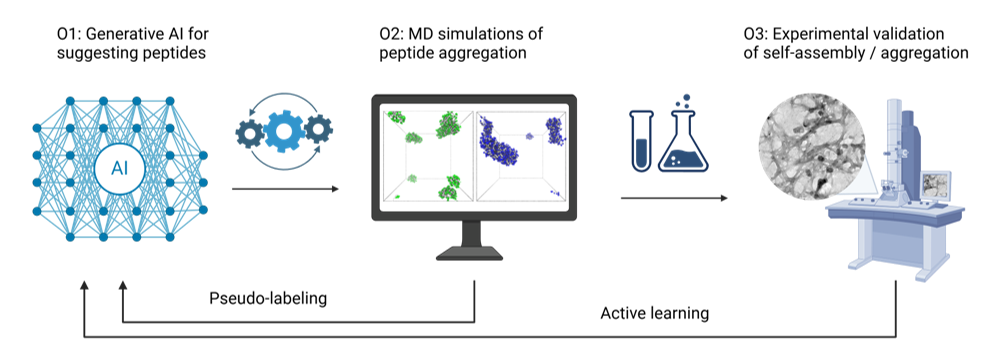
Project overview illustrating the integration of generative artificial intelligence (AI), molecular dynamics (MD) simulations, and experimental validation, highlighting two complementary strategies, pseudo-labeling and active learning, aimed at improving the likelihood of successful project outcomes.
Project description
Can Artificial Intelligence Accelerate the Discovery of New Functional Materials?
The SuPer DeShPet 2.0 explores this possibility by integrating generative artificial intelligence (AI), molecular dynamics (MD) simulations, and experimental characterization into a unified approach to discovering and understanding supramolecular peptide materials.
Peptides are particularly promising building blocks for biomaterials due to their ability to spontaneously organize into complex supramolecular structures through a process known as self-assembly. However, predicting their behaviour remains a major scientific challenge, as even small changes in amino acid sequence or experimental conditions can influence material formation and properties. Additional challenges include the limited integration of computational and experimental research, the lack of standardized datasets, and difficulties in reproducing experimental results.
SuPer DeShPet 2.0 aims to overcome these challenges by integrating three complementary approaches. Generative AI models based on neural networks will be used to propose new peptide sequences with high self-assembly propensity. Molecular dynamics (MD) simulations, with particular emphasis on coarse-grained models, will provide insights into the molecular mechanisms of peptide aggregation and the influence of different conditions on peptide behaviour. The most promising peptide candidates will then be experimentally characterized using appropriate spectroscopic and microscopic techniques to investigate their structural properties and ability to form supramolecular materials.
A key contribution of the project lies in the continuous exchange of information between AI, MD, and experiments. Computational and experimental results will be used to iteratively improve predictive models through active learning, enabling them to account not only for amino acid sequences but also for the conditions under which self-assembly occurs. This iterative approach will facilitate more efficient exploration of the vast peptide sequence space, targeted selection of promising candidates, and a reduced need for extensive experimental screening.
The main aim of the project is to develop an integrated computational–experimental framework for the discovery of new supramolecular peptide materials, as well as other peptide-based systems, enabling a deeper understanding of the relationship between amino acid sequence and material function. Looking ahead, SuPer DeShPet 2.0 will contribute to the development of more reliable approaches for predicting and controlling peptide aggregation, opening new opportunities for more efficient, rational, and sustainable discovery of functional biomaterials.
Research group
- assoc. prof. Daniela Kalafatović1 – principal investigator
- prof. Goran Mauša1
- assist. prof. Toni Todorovski2
- assoc. prof. Marta De Zotti3
- group leader Dr. Ivan Ramos Sasselli4
- assist. prof. Erik Otović5
- Dr. Patrizia Janković Bevandić2,6
- Ena Dražić1
- Marko Babić1
1 Faculty of Engineering, University of Rijeka
2 Faculty of Biotechnology and Drug Development, University of Rijeka
3 Department of chemical sciences, University of Padova, Italy
4 Centro de Fisica de Materiales/Materials Physics Center (CFM/MPC), San Sebastian, Španjolska
5 Faculty of Engineering in Pula, Juraj Dobrila University of Pula
6 Jadran-galenski laboratorij (JGL), Rijeka
Funding
Funded by Croatian Science Foundation, grant number IP-2025-02-3357.

Publications
- Solving the Computational Peptide Design Puzzle: Challenges and Opportunities, ACS Omega,
- G. Mauša, D. Kalafatovic (2026). Data-driven surrogates of rational design enable antimicrobial peptide optimization, Nature Machine Intelligence, Vol. 8, pp 1020–1022, https://doi.org/10.1038/s42256-026-01258-0
- M. Babić, G. Mauša, I. R. Sasselli, D. Kalafatovic (2026). Secondary Structure Bead-Encoded Amphiphilicity Biases Peptide Self-Assembly Prediction in MARTINI Coarse-Grained Simulations, ACS Applied Materials & Interfaces, Vol. 18 (8), pp. 12353–12367, https://pubs.acs.org/doi/10.1021/acsami.5c14754
Conferences
- K. Barjaktarić, P. Paunović, L. Lečić, E. Otović, J. Calvario, A. S. Pina, Y. Kawaguchi, D. Kalafatovic, G. Mauša (2026) Data-driven Prediction of Liquid-Liquid Phase Separation, Boulder Peptide Symposium 2026
- D. Ibiši, D. Kalafatovic, G. Mauša (2026) Guiding Peptide Sequence Generation with Active Learning for Discovery of Self-Assembling, 38th European Peptide Symposium Proceedings
- M. Injac, E. Dražić, M. Njirjak, G. Rakić, D. Kalafatovic, G. Mauša (2026) Adaptive Evolutionary Optimization for the Discovery of Self-Assembling, 38th European Peptide Symposium Proceedings
- E. Dražić, H. S. Azevedo, D. Kalafatovic (2026) Peptide Self-assembly Beyond Known Design Principles: Sequence and Context Interplay, 38th European Peptide Symposium Proceedings
- E. Dražić, H. S. Azevedo, D. Kalafatovic (2026) Context-dependent challenges in short peptide self-assembly, TERMIS-EU 2026