Project overview
Bone fractures are defined as breaks in the continuity of the bone cortex, often accompanied by soft tissue injuries. In the six largest European countries, over 2.7 million fracture cases are recorded annually, with as much as 3.5% of the European Union’s (EU27+2) healthcare budget allocated to this problem. With the development of deep neural networks and artificial intelligence, many studies have focused on the classification, detection, and segmentation of fractures from X-ray images, aiming to develop software and tools to assist radiologists in making accurate diagnoses. Despite the plethora of developed models and fundamental machine learning models in medicine, the impact of artificial intelligence on clinical practice remains undefined and underexplored.
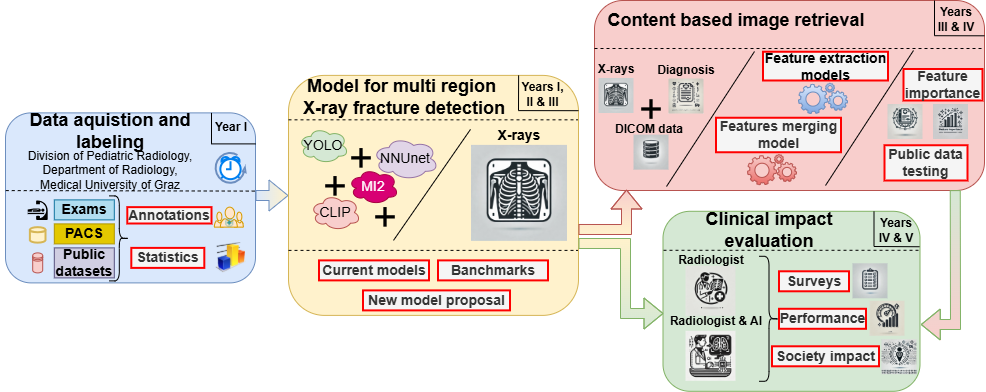
To test the hypothesis “Information obtained by the AI model on fractures has a positive impact on radiologists’ performance and patient diagnosis,” the project will develop a specially designed model for detecting pediatric fractures, trained on a collected and labeled dataset of over 180,000 pediatric X-ray images from the University Hospital in Graz. After fracture detection, a method for content-based case retrieval will first extract characteristics from the radiograph, the fracture region, the diagnosis, and the image attributes. Then, an innovative model will be developed to integrate these extracted features into a common space where similar cases can be easily matched. This approach represents a significant step toward personalized medicine, as it will provide the radiologist not only with the detected fracture region but also with insight into similar cases.
Finally, a clinical study will be conducted in the hospital to assess the benefits of the developed models for both radiologists and patients. This research represents a step forward in pediatric fracture detection and opens the potential to develop a software that can influence clinical practice and contribute to the improvement of healthcare.
Research Group
- assist. prof. Franko Hržić 1 — principal investigator
- assist. prof. Nikola Lopac 2
- prof. Sebastian Tschauner M.D.3
- Ph.D. Ana Trišović4
- Ph.D. Mateja Napravnik 1
- mag. ing. comp. Boris Gašparović 1
1 University of Rijeka, Faculty of Engineering, Croatia; 2 University of Rijeka, Faculty of Maritime Studies, Croatia; 3 Medical University of Graz, Austria; 4 Massachusetts Institute of Technology, SAD
Funding
Funded by Croatian Science Foundation grant UIP-2025-02-6365. Project funding: 203,722.50 Eur (2026-2031).