

Project acronym: MOPED
Grant number: IP-2026-4962
Duration: 2026 – 2029
Budget: 196.650,00 €
Abstract
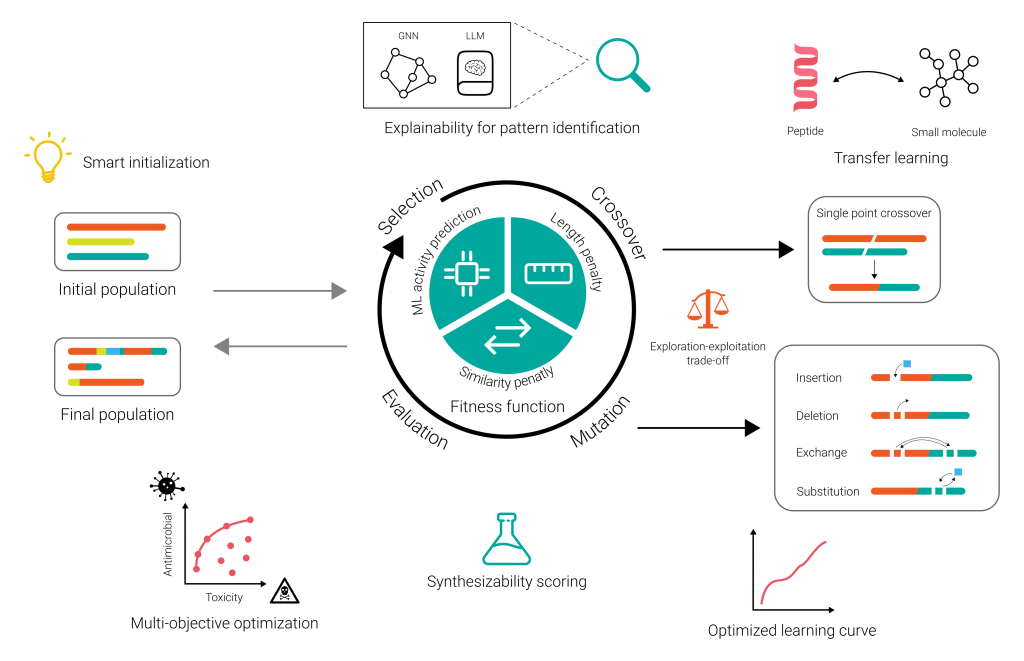
Peptides hold enormous potential for medicine and biotechnology, but discovering new functional sequences remains challenging due to the vast number of possibilities and competing design requirements.
MOPED aims to make peptide discovery smarter, more efficient, and more sustainable by developing a modular AI-powered software platform for exploring and optimizing peptide sequences. Unlike conventional approaches, MOPED enables researchers to dynamically balance competing objectives, such as antimicrobial activity versus toxicity or self-assembly versus synthesizability.
By combining generative AI, explainable deep learning, transfer learning, and expert knowledge, MOPED will support the discovery of functional peptides that are both effective and experimentally feasible.
The resulting open and reusable software framework will advance our understanding of peptide sequence–function relationships, improve reproducibility, and support innovation in antimicrobial therapeutics, biomaterials, and biotechnology.
Research group
- prof. Goran Mauša1 – principal investigator
- assoc. prof. Daniela Kalafatović1
- assist. prof. Toni Todorovski2
- assist. prof. Erik Otović3
- assoc. prof. Marta De Zotti4
- group leader Mathijs Mabesoone5
- postdoc Marko Njirjak1
- Ena Dražić1
1 Faculty of Engineering, University of Rijeka
2 Faculty of Biotechnology and Drug Development, University of Rijeka
3 Faculty of Engineering in Pula, Jurja Dobrile University of Pula
4 Department of chemical sciences, University of Padova
5 Physical Organic Chemistry department, Radboud University, Nijmegen
Funding
Funded by Croatian Science Foundation grant IP-2026-4962.
Conferences
- K. Barjaktarić, P. Paunović, L. Lečić, E. Otović, J. Calvario, A. S. Pina, Y. Kawaguchi, D. Kalafatovic, G. Mauša (2026) Data-driven Prediction of Liquid-Liquid Phase Separation, BPS 2026
- K. Barjaktarić, J. Calvario, A. S. Pina, Y. Kawaguchi, D. Kalafatovic, G. Mauša (2026) Transfer Learning for Prediction of Liquid-Liquid Phase Separation, EPS 2026