

Head: Assoc. Prof. Ervin Kamenar
Research Area
The Laboratory for Bioinspired Robotics focuses on the development of robotic systems inspired by principles found in nature, with a particular emphasis on soft robotics. Its work includes the design and fabrication of soft robotic actuators, modeling of dynamic systems, application of machine learning methods in modeling and control, and the integration of biomedical sensors into robotic systems.
A significant research direction of the laboratory is the application of Koopman operator theory for developing data-driven models and controllers, as well as their implementation in robotic systems. This approach enables efficient approximation of nonlinear dynamics within a linear framework, opening new possibilities for advanced control, prediction, and optimization.
Special emphasis is given to applications in rehabilitation robotics and safe human–robot interaction, supported by a strong experimental component and active involvement of students in research activities.
Activities of the Laboratory for Bioinspired Robotics
The activities and news of the laboratory and the research group are available on external link.
Key Laboratory Equipment
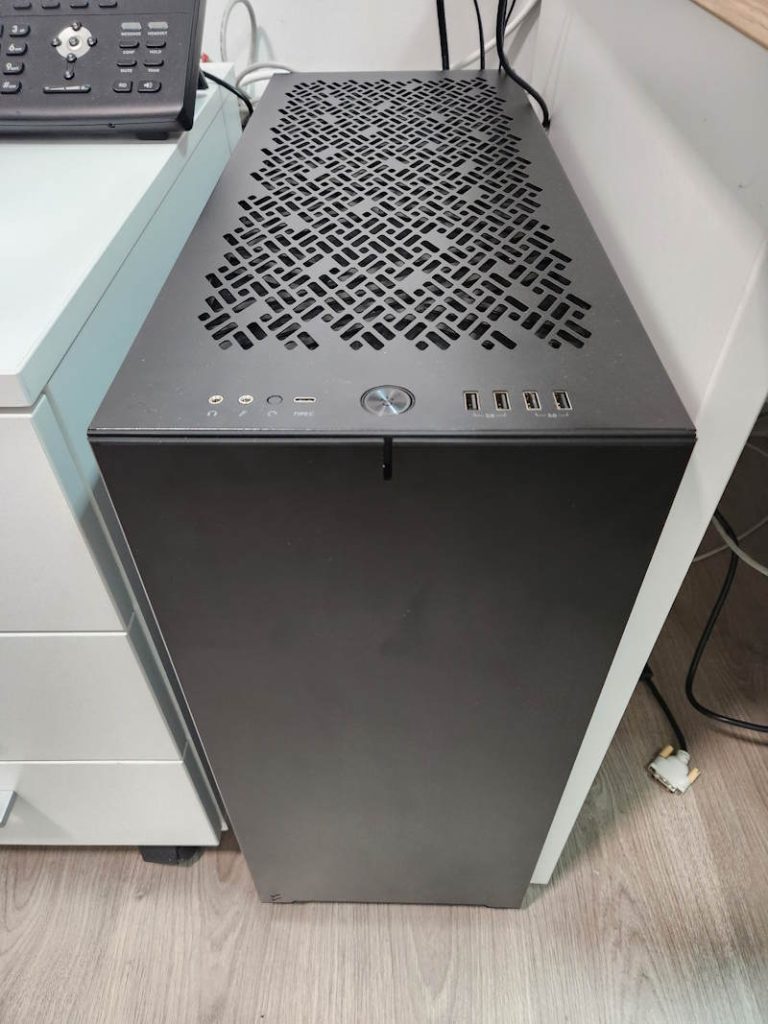
High-Performance Workstation for EMG, Motion Tracking, and Advanced Modeling
The workstation is intended for computationally demanding research in rehabilitation and bioinspired robotics, electromyography (EMG), motion tracking, numerical modeling, and advanced control.
The system is built around an AMD Ryzen Threadripper PRO 9975WX processor with 32 cores and 64 threads, supported by 256 GB of DDR5 ECC memory and an NVIDIA RTX PRO 4500 Blackwell professional graphics card with 32 GB of ECC graphics memory. The workstation provides a total of 6 TB of NVMe SSD storage, high-speed network connectivity, and a Linux/ROS 2 software environment.
The equipment is primarily intended for connecting, synchronizing, and processing data from multichannel EMG systems and motion-tracking systems, as well as for numerical simulations, machine-learning methods, and the development of data-driven models and control algorithms.
The acquisition of the equipment was funded by the Croatian Science Foundation (HRZZ) and by the European Union through the University of Rijeka (UNIRI).
Part of the equipment was funded within the ASoRo project – Advanced Soft Robots: Data-Driven Development, Modeling and Control (UIP-2025-02-1541), while the remaining part was funded within the project sEMG Signal Decomposition for Rehabilitation Robotics Using Koopman Operator Theory (uniri-iz-25-116), funded by the European Union – NextGenerationEU.
Within these projects, the workstation is used for:
- processing and synchronization of multichannel EMG and biomechanical data
- processing motion-tracking data and kinematic analysis
- development and training of data-driven Koopman models
- development of advanced control algorithms for soft and rehabilitation robots

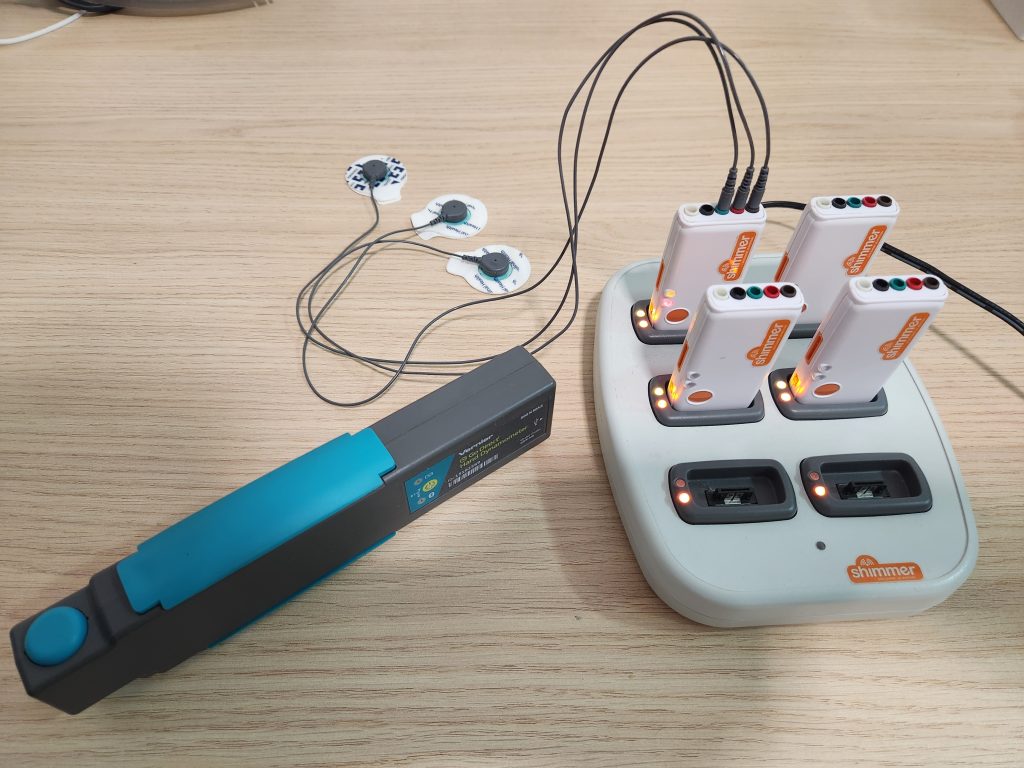
EMG system and dynamometer for measuring muscle activity and grip force
Shimmer3 units. The laboratory is equipped with four Shimmer3 EMG units for measuring electromyographic (EMG) signals, along with a complete Consensys EMG development kit. These are wireless, non-invasive sensors designed to measure muscle electrical activity in real-time. The systems enable data acquisition on muscle activation, assessment of muscle activity and movement biomechanics, as well as analysis of coordination, fatigue, and neuromuscular patterns.
Vernier hand dynamometer. This hand dynamometer is used to validate grip force measurements and assess muscle strength. The device enables reliable quantitative evaluation of the biomechanical characteristics of the hand and forearm muscles and serves to verify experimental results.
This equipment is used for:
- Development and validation of measurement systems in rehabilitation robotics.
- Data acquisition for developing data-driven models using Koopman operator methods.
- Integration of biosignals into control systems of soft robotic actuators for rehabilitation applications.
- Correlation analysis between muscle activity and generated force.
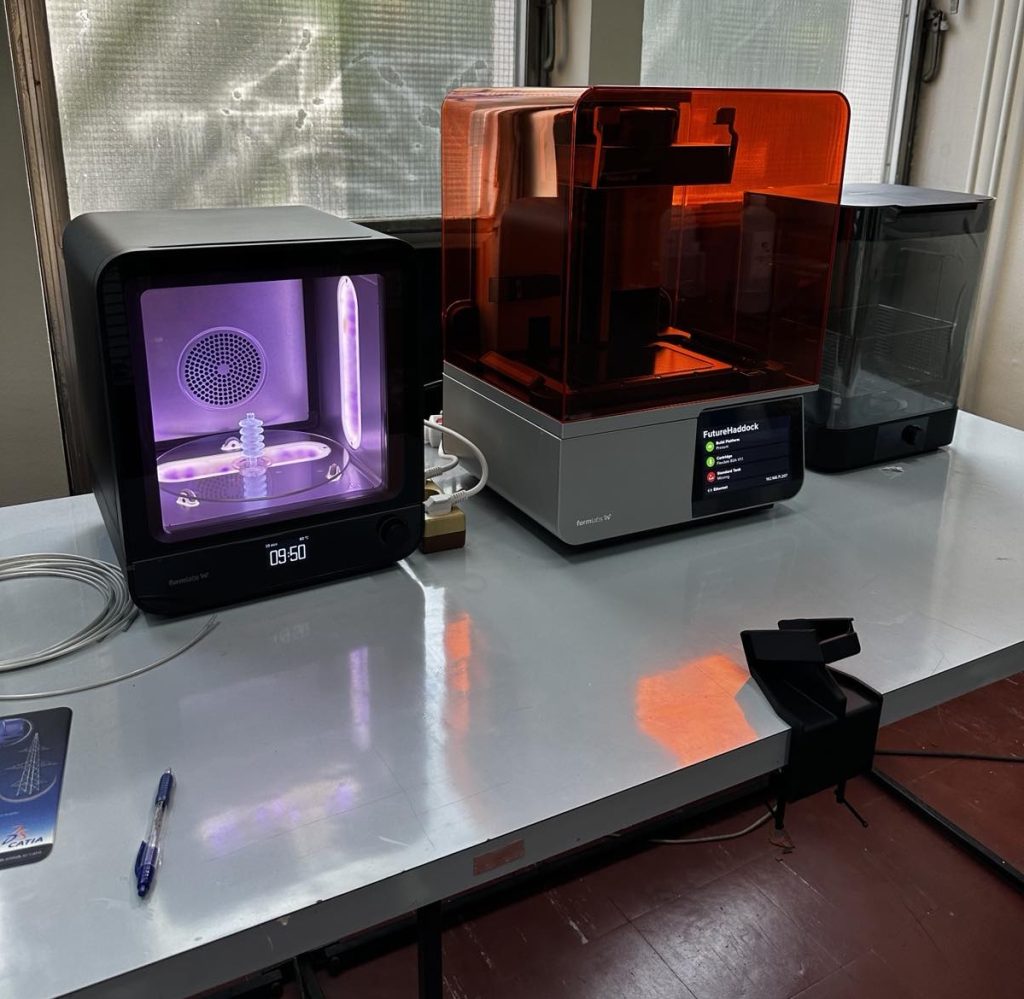
Formlabs Form 4 System for 3D Printing Soft Robotic Components
The system is shared research equipment of the Laboratory for Mechatronic Systems Design, the Laboratory for Hydraulics and Pneumatics, and the Laboratory for Bioinspired Robotics at the Faculty of Engineering, University of Rijeka.
The system includes a professional Formlabs Form 4 stereolithography 3D printer, intended for the fabrication of precise prototypes and functional components from photopolymer resins. The technology enables the production of parts with complex geometries, thin walls, and fine structural details, which is particularly important for the development of soft pneumatic actuators, bioinspired robots, wearable rehabilitation devices, and other mechatronic systems.
The printer is accompanied by Form Wash V2 and the second-generation Form Cure. Form Wash enables automated cleaning of printed parts and removal of residual resin, while Form Cure provides controlled UV curing and thermal treatment to achieve the final mechanical properties of the material. The system also includes a flexible build platform, a resin tank and mixer, and supporting equipment for post-processing.
The equipment is used for:
- developing and fabricating prototypes of soft robotic actuators, bioinspired robots, and rehabilitation devices
- producing kirigami structures, complex pneumatic channels, thin-walled structures, and customized components
- testing new structural concepts and flexible photopolymer materials
- experimentally characterizing and numerically modeling hyperelastic materials
- validating models developed using the finite element method and data-driven approaches
- rapidly fabricating and refining prototypes during iterative development
The system was funded through the University of Rijeka projects “Experimental Characterization and Numerical Modeling of Hyperelastic Materials for Soft Robotics Applications” and “Biomimetic Soft Pneumatic Robots Based on Kirigami Design.”
Active Projects
Advanced Soft Robots: Data-Driven Development, Modeling and Control (2026–2031)
This Croatian Science Foundation project focuses on the development of advanced soft robots. The research includes biomechatronic design, material selection and characterization, mathematical and numerical modeling, and the development of data-driven control methods based on Koopman operator theory.
Particular emphasis is placed on the application of soft robots in robotic rehabilitation, the measurement of muscle activity using surface electromyography, and the real-time estimation and prediction of grip force. The project brings together engineering and medical research to develop adaptive, safe, and effective rehabilitation devices.
More about the HRZZ project and its activities
Koopman-driven real-time sEMG signal decomposition for robotic rehabilitation (2025–2029)

This University of Rijeka project focuses on the development of methods for the real-time decomposition of surface electromyographic signals using Koopman operator theory and Dynamic Mode Decomposition. The aim is to identify motor-unit activity and relate it to grip force across different types of grasp.
The developed methods are expected to enable more accurate, interpretable, and computationally efficient analysis of muscle activity. The results will be used to develop adaptive soft robotic rehabilitation systems capable of responding in real time to muscle activity and the individual needs of users.
More about the UNIRI project and its activities
Selected publications
Bazina, T., Kamenar, E., Fonoberova, M., & Mezić, I. (2025). Koopman-driven grip force prediction through EMG sensing. IEEE Transactions on Neural Systems and Rehabilitation Engineering.
Haggerty, D. A., Banks, M. J., Kamenar, E., Cao, A. B., Curtis, P. C., Mezić, I., & Hawkes, E. W. (2023). Control of soft robots with inertial dynamics. Science robotics, 8(81), eadd6864.