

Head: Assoc. Prof. Ervin Kamenar
Research Area
The Laboratory for Bioinspired Robotics focuses on the development of robotic systems inspired by principles found in nature, with a particular emphasis on soft robotics. Its work includes the design and fabrication of soft robotic actuators, modeling of dynamic systems, application of machine learning methods in modeling and control, and the integration of biomedical sensors into robotic systems.
A significant research direction of the laboratory is the application of Koopman operator theory for developing data-driven models and controllers, as well as their implementation in robotic systems. This approach enables efficient approximation of nonlinear dynamics within a linear framework, opening new possibilities for advanced control, prediction, and optimization.
Special emphasis is given to applications in rehabilitation robotics and safe human–robot interaction, supported by a strong experimental component and active involvement of students in research activities.
Activities of the Laboratory for Bioinspired Robotics
The activities and news of the laboratory and the research group are available on external link.
Key Laboratory Equipment
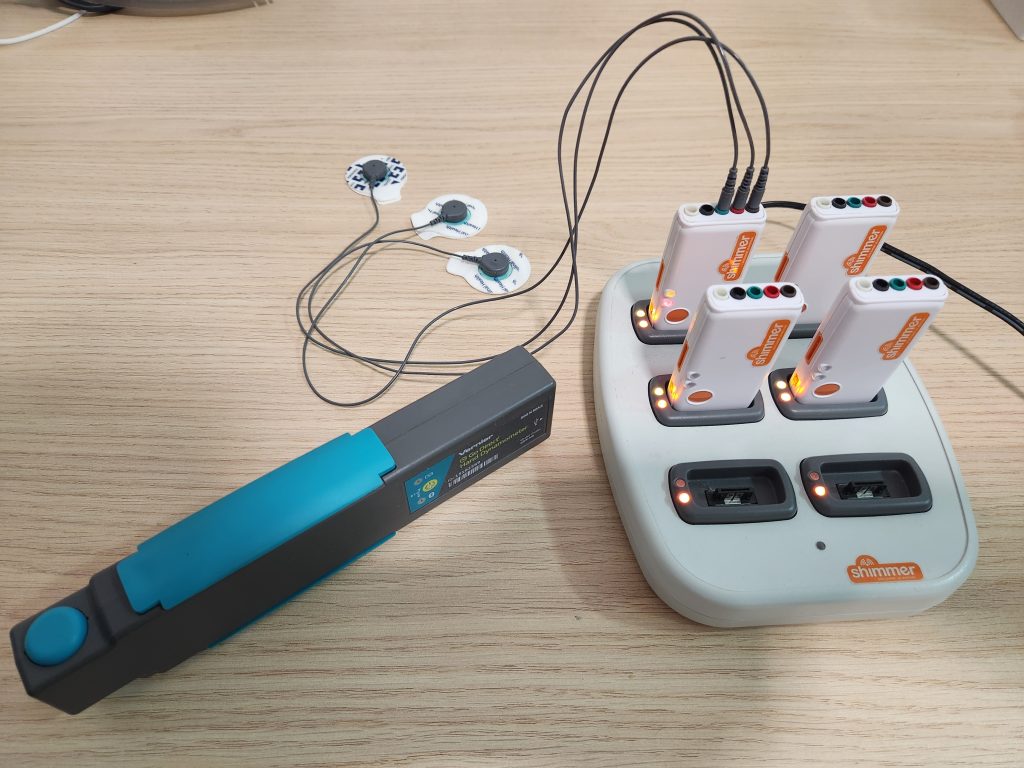
EMG system and dynamometer for measuring muscle activity and grip force
Shimmer3 units. The laboratory is equipped with four Shimmer3 EMG units for measuring electromyographic (EMG) signals, along with a complete Consensys EMG development kit. These are wireless, non-invasive sensors designed to measure muscle electrical activity in real-time. The systems enable data acquisition on muscle activation, assessment of muscle activity and movement biomechanics, as well as analysis of coordination, fatigue, and neuromuscular patterns.
Vernier hand dynamometer. This hand dynamometer is used to validate grip force measurements and assess muscle strength. The device enables reliable quantitative evaluation of the biomechanical characteristics of the hand and forearm muscles and serves to verify experimental results.
This equipment is used for:
- Development and validation of measurement systems in rehabilitation robotics.
- Data acquisition for developing data-driven models using Koopman operator methods.
- Integration of biosignals into control systems of soft robotic actuators for rehabilitation applications.
- Correlation analysis between muscle activity and generated force.
Selected publications
Bazina, T., Kamenar, E., Fonoberova, M., & Mezić, I. (2025). Koopman-driven grip force prediction through EMG sensing. IEEE Transactions on Neural Systems and Rehabilitation Engineering.
Haggerty, D. A., Banks, M. J., Kamenar, E., Cao, A. B., Curtis, P. C., Mezić, I., & Hawkes, E. W. (2023). Control of soft robots with inertial dynamics. Science robotics, 8(81), eadd6864.