

The STEM/ICT Innovation Laboratory for Industry 4.0 is being established at the Faculty of Engineering, University of Rijeka, within the framework of the project RITEH “Open Innovation Gate” – STEM/ICT Innovation Laboratory for Industry 4.0, project code NPOO.C3.2.R2-I2.12.0024.
The project aims to develop modern research and innovation infrastructure dedicated to the development, testing, and demonstration of advanced technologies in industrial automation, robotics, digital manufacturing, computer vision, artificial intelligence, and cyber-physical production systems.
The laboratory is designed as an open platform for researchers, academic staff, students, early-career researchers, companies, and other partners interested in developing solutions in the field of Industry 4.0.
Purpose of the Laboratory
By establishing the laboratory, the Faculty of Engineering, University of Rijeka, is strengthening its research and innovation capacities in STEM and ICT fields, with a particular focus on mechatronics, industrial automation, robotics, digital twins, artificial intelligence, computer vision, and advanced manufacturing technologies.
The laboratory enables the experimental testing of industrial processes in a controlled yet realistic environment. This creates the necessary conditions for applied research, prototype development, cooperation with industry, and the transfer of knowledge and technologies to the industrial sector.
New Research Equipment
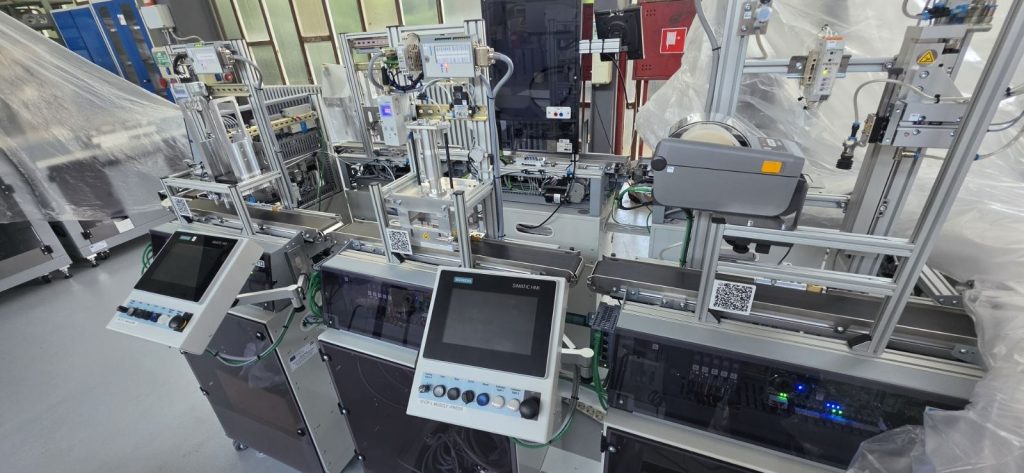
The central component of the laboratory is an integrated laboratory and research system for advanced automation and manufacturing technologies, designed as a modular mini smart factory. The system comprises transport, robotic, storage, inspection, measurement, logistics, and control modules interconnected into a unified cyber-physical system.
New Equipment Includes:
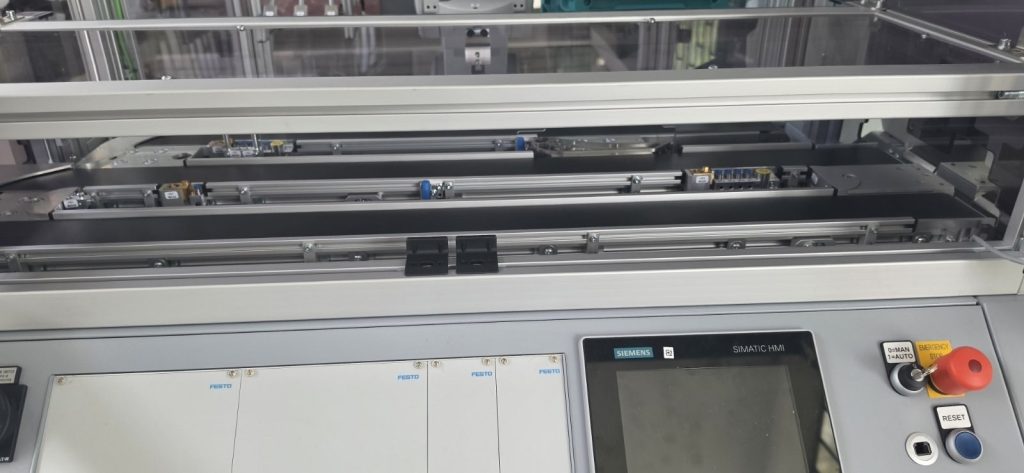
- Festo CP Lab and CP Factory systems for the simulation and research of interconnected manufacturing processes
- pallet transport systems with RFID-based workpiece identification
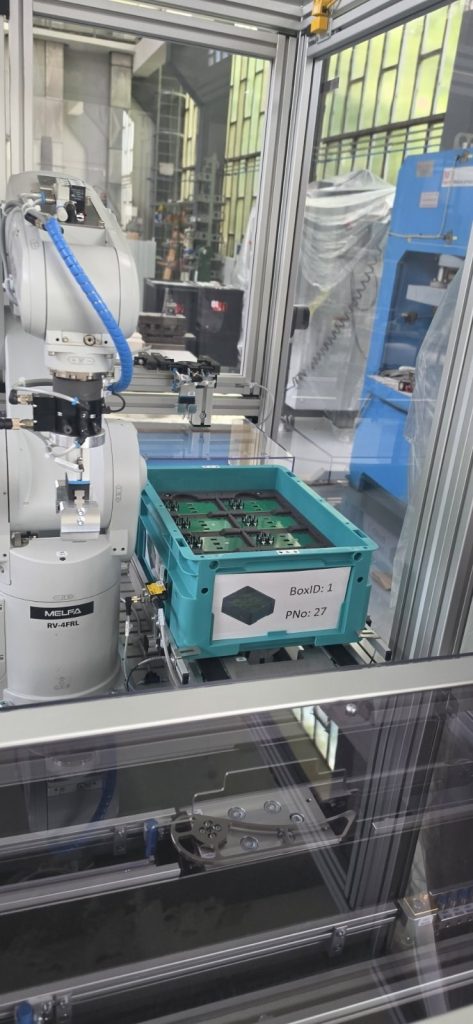
- robotic assembly station equipped with a Mitsubishi industrial robot
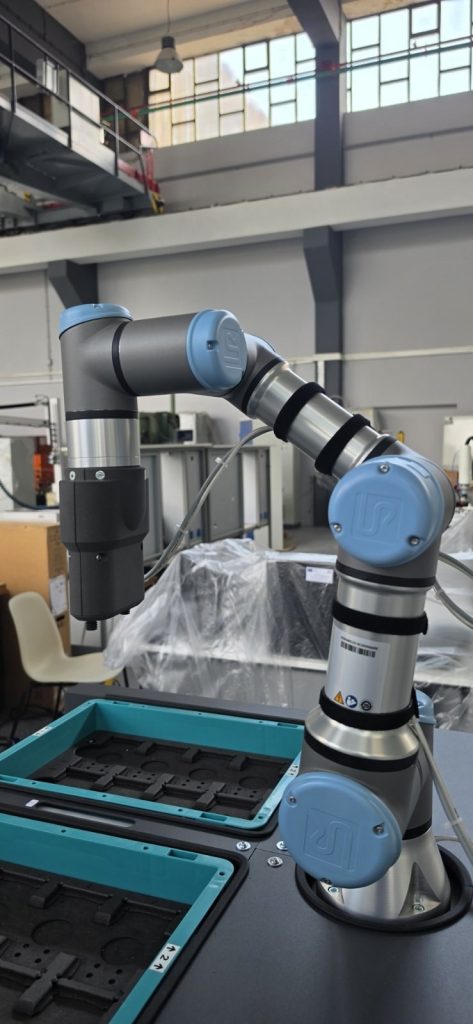
- UR3e collaborative robotic station for research into human–robot collaboration
- Robotino mobile robot for autonomous logistics and AGV applications
- ASRS automated storage and retrieval system for pallet storage and retrieval
- application modules for measurement, dispensing, marking, pressing, storage, and workpiece output
- camera inspection and machine vision module
- additional AI/ML packages for machine learning, visual inspection, and human-robot collaboration
- the MES4 system for production management and order tracking
- software tools for digital twins, simulation, analytics, energy efficiency, and mobile robot fleet management
- IoT and energy measurement modules for monitoring electricity and compressed-air consumption
Research and Development Capabilities
The laboratory supports research and development in the fields of industrial automation, PLC control, cyber-physical production systems, digital twins and production-line simulation, industrial communication protocols, computer vision, artificial intelligence, and machine learning in manufacturing.
Particular emphasis is placed on predictive maintenance, system condition monitoring, autonomous mobile robotics, intralogistics, collaborative robotics, human–robot interaction, and the optimization of production processes, material flows, and energy flows.
The system is designed as a flexible research platform that can be configured for a wide range of scenarios, from simple educational exercises to complex industrial experiments and the validation of novel algorithms in a realistic production environment.
Integration of Science, Education, and Industry
The laboratory will serve as an open platform for cooperation between the Faculty of Engineering and companies, research institutions, and international partners. A particular strength of the laboratory lies in its ability to integrate expertise from mechanical engineering, electrical engineering, computer science, mechatronics, and information and communication technologies within a single environment.
For students and early-career researchers, the laboratory provides hands-on experience with technologies used in modern industrial systems. For companies, particularly small and medium-sized enterprises, it provides access to equipment for prototype testing, proof-of-concept validation, process optimization, and the development of digital solutions without requiring major investments in their own research infrastructure.
Project Team
| Name and Surname | Role | Contact |
| Assoc. Prof. Nikola Anđelić | Project Leader | nikola.andjelic@riteh.uniri.hr |
| Research Assistant Matko Glučina | Project Associate | matko.glucina@riteh.uniri.hr |
| Prof. Zoran Jurković | Project Associate | zoran.jurkovic@riteh.uniri.hr |
| Assoc. Prof. Goran Gregov | Project Associate | goran.gregov@riteh.uniri.hr |
| Assoc. Prof. Rene Prenc | Project Associate | rene.prenc@riteh.uniri.hr |
| Assoc. Prof. Ervin Kamenar | Project Associate | ekamenar@riteh.uniri.hr |
| Assoc. Prof. Sandro Doboviček | Project Associate | sandro.dobovicek@riteh.uniri.hr |
| Assoc. Prof. David Ištoković | Project Associate | distokovic@riteh.uniri.hr |
| Prof. Jonatan Lerga | Project Associate | jonatan.lerga@riteh.uniri.hr |
| Prof. Kristijan Lenac | Project Associate | kristijan.lenac@riteh.uniri.hr |
| Kristina Jurić Gržeta | Project Associate | kristina.juric@riteh.uniri.hr |
Funding and Project Implementation
The project is funded through the Recovery and Resilience Facility, under the call Investment in Equipping and Adaptation of Research and Innovation Infrastructure. The total value of the project is EUR 839,966.65, and the project implementation period runs from 15 January 2026 to 15 June 2026.
The project is implemented under a Grant Agreement for projects financed through the Recovery and Resilience Facility. The body responsible for Component/Subcomponent C3.2, “Enhancing Research and Innovation Capacity,” is the Ministry of Science, Education and Youth, while the project is financed within the framework of the National Recovery and Resilience Plan 2021–2026.
Personnel Authorized to Operate the Equipment
The following individuals have completed training provided by Festo for the operation and control of the system:
- Assoc. Prof. Nikola Anđelić, PhD (e-mail: nikola.andjelic@riteh.uniri.hr)
- Matko Glučina, MSc EE, Research Assistant (e-mail: matko.glucina@riteh.uniri.hr)
- Assoc. Prof. David Ištoković, PhD (e-mail: distokovic@riteh.uniri.hr)
- Assoc. Prof. Vedran Mrzljak, PhD (e-mail: vedran.mrzljak@riteh.uniri.hr)
- Assoc. Prof. Goran Gregov, PhD (e-mail: goran.gregov@riteh.uniri.hr)
- Assoc. Prof. Ervin Kamenar, PhD (e-mail: ekamenar@riteh.uniri.hr)
- Senior Research Assistant Tomislav Bazina, PhD (e-mail: tomislav.bazina@riteh.uniri.hr)
- Senior Research Assistant Ivan Markovinović, PhD (e-mail: ivan.markovinovic@riteh.uniri.hr)
To use the equipment, users are required to contact one of the authorized persons listed above.
Link to the RITEH “Open Innovation Gate” – STEM/ICT Innovation Laboratory for Industry 4.0 project.
Published Scientific Papers
- Bazina, T., Kopajtić, L., Kamenar, E., & Gregov, G. (2026, September). Data-Driven Position Control of a McKibben Pneumatic Artificial Muscle: Simulation and Experimental Validation of PID and LQI Controllers. In Actuators. Multidisciplinary Digital Publishing Institute.