

Project code: uniri-mzi-25-33
Financing: UNIRI projects for materially demanding research

Project duration: 1. 10. 2025. – 30. 9. 2029.
ABSTRACT
Research on the project is focused on increasing the efficiency of heat exchange in green energy systems. The project activities include experimental measurements on the fin and tube heat exchangers and on the latent heat storage as well as the analyses of the results obtained from experimental research. For selected types of heat exchangers and heat storage, the physical problems of heat exchange will be described, appropriate mathematical models will be defined, numerical procedures will be selected and validations will be carried out by comparing numerical results with the results of experimental measurements performed on established test lines for heat exchangers and latent heat storage. Throughout the numerical research, a series of computational simulations will be carried out for various geometry characteristics and operating conditions of the heat exchangers and heat storage, using experimentally validated numerical models. Parametric analyses of the influence of geometry characteristics and operating conditions on heat exchange and efficiency will be performed. Also, optimization procedures of the influencing parameters will be carried out in order to find their optimal values with the aim of increasing the efficiency of heat exchange in green energy systems. The objective of the research is to improve the heat exchange efficiency in renewable energy systems contributing to the green transition. The project objectives include improving heat exchange by optimizing the geometry characteristics and operating conditions of fin and tube heat exchangers, as well as increasing the efficiency of green energy storage by optimizing the geometry and operating parameters of the latent heat storage. The expected scientific contribution of the research includes the development, validation and application of advanced computational tools for performing thermodynamic analyses and optimization procedures of heat exchange and heat storage components in green energy systems, contributing to the green transition, energy saving and sustainable development.
Key words: thermal energy exchange, latent heat storage, computational and experimental analysis, optimization of geometry and operating parameters
.
RESEARCH GROUP
Prof. D. Sc. Anica Trp – project leader
Prof. D. Sc. Kristian Lenić
Prof. D. Sc. Igor Wolf
Assoc. Prof. D. Sc. Igor Bonefačić
Assoc. Prof. D. Sc. Boris Delač
Assoc. Prof. D. Sc. Vladimir Glažar
Assist. Prof. D. Sc. Robert Baždarić
Assist. Prof. D. Sc. Mateo Kirinčić
Senior Assist. D. Sc. Josip Batista
Assist. Ugo Gruden
.
OBJECTIVES
1. Contributing to the green transition by improving heat exchange efficiency in renewable energy systems (main objective).
2. Optimization of fin and tube heat exchangers geometry characteristics with the aim of improving heat transfer.
3. Increasing heat exchange efficiency by analyzing the impact of fin and tube heat exchangers operating conditions.
4. Increasing the efficiency of green energy storage by optimizing the geometry and operating parameters of the latent heat storage.
.
METHODOLOGY
The research methodology of the project includes experimental measurements, numerical calculations and optimization.
1. Experimental research
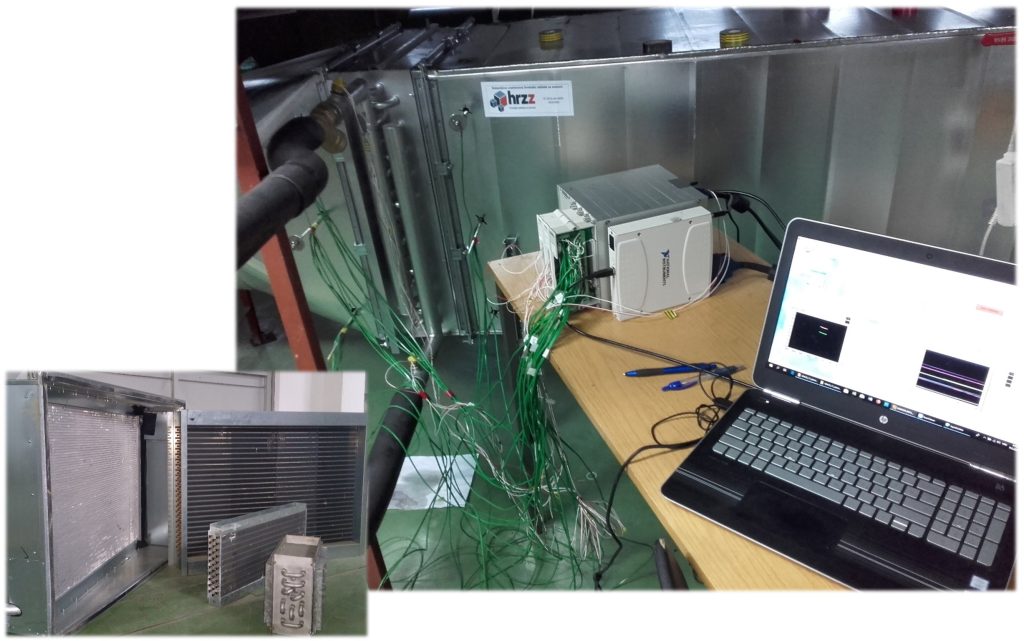
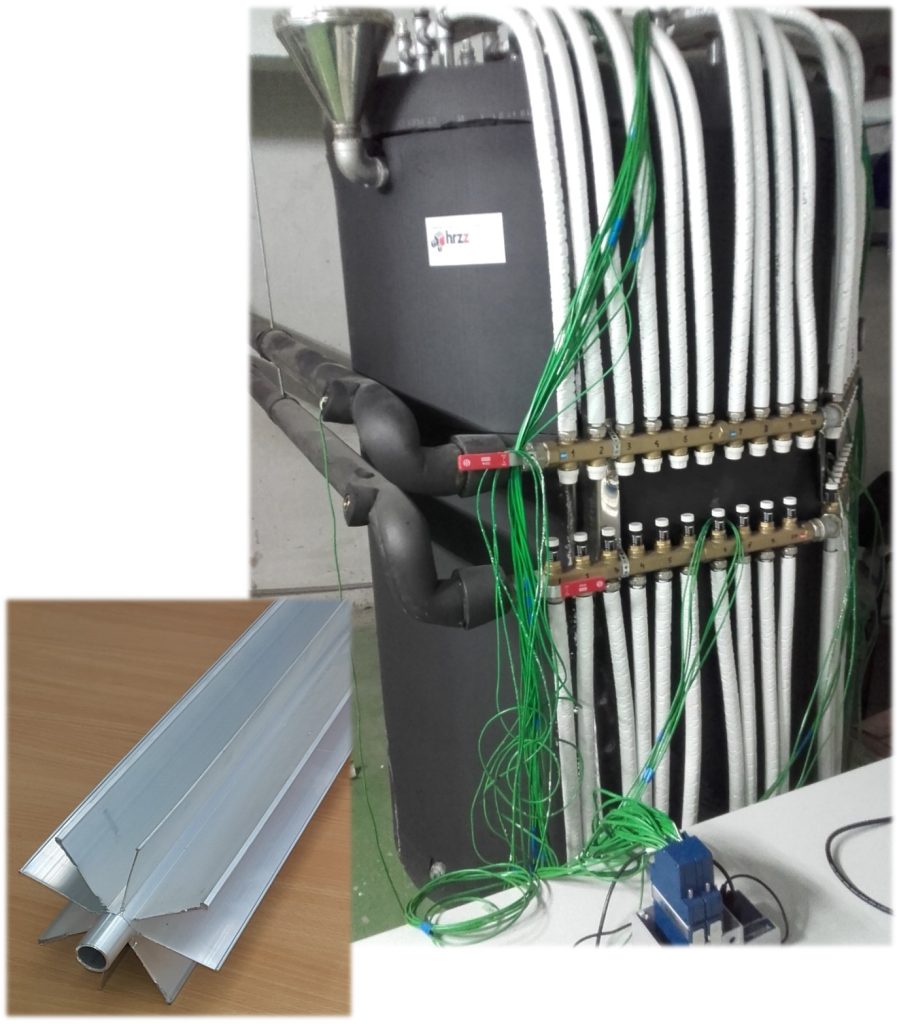
Experimental research will be performed in the laboratories of the Department of Thermodynamics and Energy Engineering at the Faculty of Engineering. The existing experimental equipment will be upgraded and supplemented with new components of the heat exchanger test line, including test heat exchangers, measurement sensors, and control and data acquisition systems. During the experimental research, a standard measurement methodology will be used, which includes sensor calibration, measurement uncertainty assessment, and statistical analysis of the collected data. It is planned to perform experimental research in test and real conditions. Experimental research will be used for experimental analysis and validation of computational procedures.
2. Computational simulations
In order to perform numerical analyses of heat transfer in heat exchangers and latent heat storage as a special type of heat exchanger, the appropriate domains will be defined together with the conservation equations as well as the initial and boundary conditions. Numerical solutions will be performed, based on the control volume method, using an experimentally validated numerical procedure and CFD software. After that, numerical analyses will be performed for selected operating conditions and geometry characteristics of the heat exchanger and latent heat storage. Numerical investigations will enable the performance of a large number of numerical analyses and will be the basis for the implementation of optimization procedures.
3. Optimization procedures
To determine the optimal geometry characteristics and operating conditions of the heat exchanger, a genetic algorithm will be used as an optimization method. To determine the optimal values of the influencing operating and geometry parameters of the latent heat storage, the response surface optimization method and the Box-Behnken design of experiment will be used.